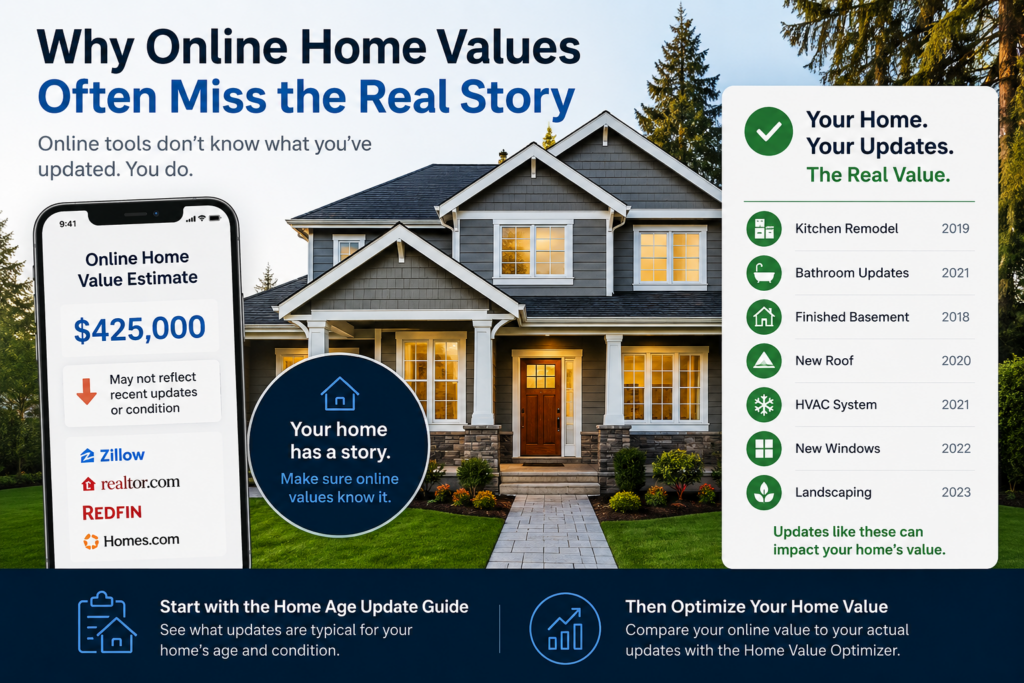
Why Online Home Values Often Miss the Real Story
If you’ve ever looked up your home’s value online and thought, “That can’t be right,” you’re not alone.
Millions of homeowners rely on online home value estimates from Zillow, Realtor.com, Redfin, Homes.com, and other portals. These tools can be useful starting points, but they often have one major limitation:
They may not know what has been updated inside your home.
The Hidden Problem with Online Home Values
Most automated valuation models (AVMs) rely heavily on public records, recent sales, and market trends. While that information is important, it may not accurately reflect improvements made over time.
For example:
- A remodeled kitchen
- Updated bathrooms
- A finished basement
- A new roof
- Modern HVAC systems
- Extensive landscaping improvements
These updates can significantly influence how buyers view a property, yet they may not be fully recognized by online valuation models.
Older Homes Face the Biggest Challenge
The issue becomes even more noticeable in homes that are 20, 30, 40, or even 50 years old.
Two homes may have been built in the same year and have similar square footage, but one may have undergone extensive renovations while the other remains largely original.
Online value estimates often struggle to recognize these differences.
That’s why homeowners are frequently surprised when an appraisal, buyer, or real estate professional arrives at a value that differs from an online estimate.
Start with Your Home’s Age
Many homeowners don’t realize how many components of a home have expected life cycles.
Roofs, HVAC systems, water heaters, windows, flooring, appliances, and kitchens all age differently.
The Home Age Update Guide helps homeowners understand what improvements may have been updated, what may be due soon, and what is often still within its expected life cycle based on the age of the property.
This creates a useful starting point for understanding how your home compares to what an online valuation model may assume.
The Next Step: Optimize Your Portal Value
Once you understand your home’s updates and improvements, the next step is to evaluate whether those features are being reflected in your online home value estimate.
The Home Value Optimizer and AVM Optimizer allow homeowners to compare their online value estimates against actual property updates that may not be fully recognized by automated systems.
The result is a more informed perspective on how upgrades, renovations, and condition may influence a property’s market perception.
A Better Starting Point
No online estimate is perfect.
No algorithm can replace a professional appraisal when one is required.
However, understanding your home’s condition, improvements, and age-related updates can provide valuable context that many online estimates simply don’t capture.
Before accepting any online home value at face value, take a closer look at what your home has become since it was built.
The difference may surprise you.
Start with your home’s age. Then compare your online value estimate to your home’s actual condition and updates.
A better understanding of your home often starts with better information.